When we talk about the success of Indian cricket, the spotlight usually falls on iconic players and match-winning performances. But behind every successful team is a core group of individuals working off the field the coaches. From guiding young talent to strategizing on the biggest stages, Indian cricket coaches play a crucial role in shaping the team’s performance and mindset.
In this article, we’ll walk through the current coaching setup of Indian cricket (for both men and women), explore the legacy of past coaches, and understand the process behind appointing these key figures.
Indian Cricket Team Coaches (1971 – 2025) — Complete List
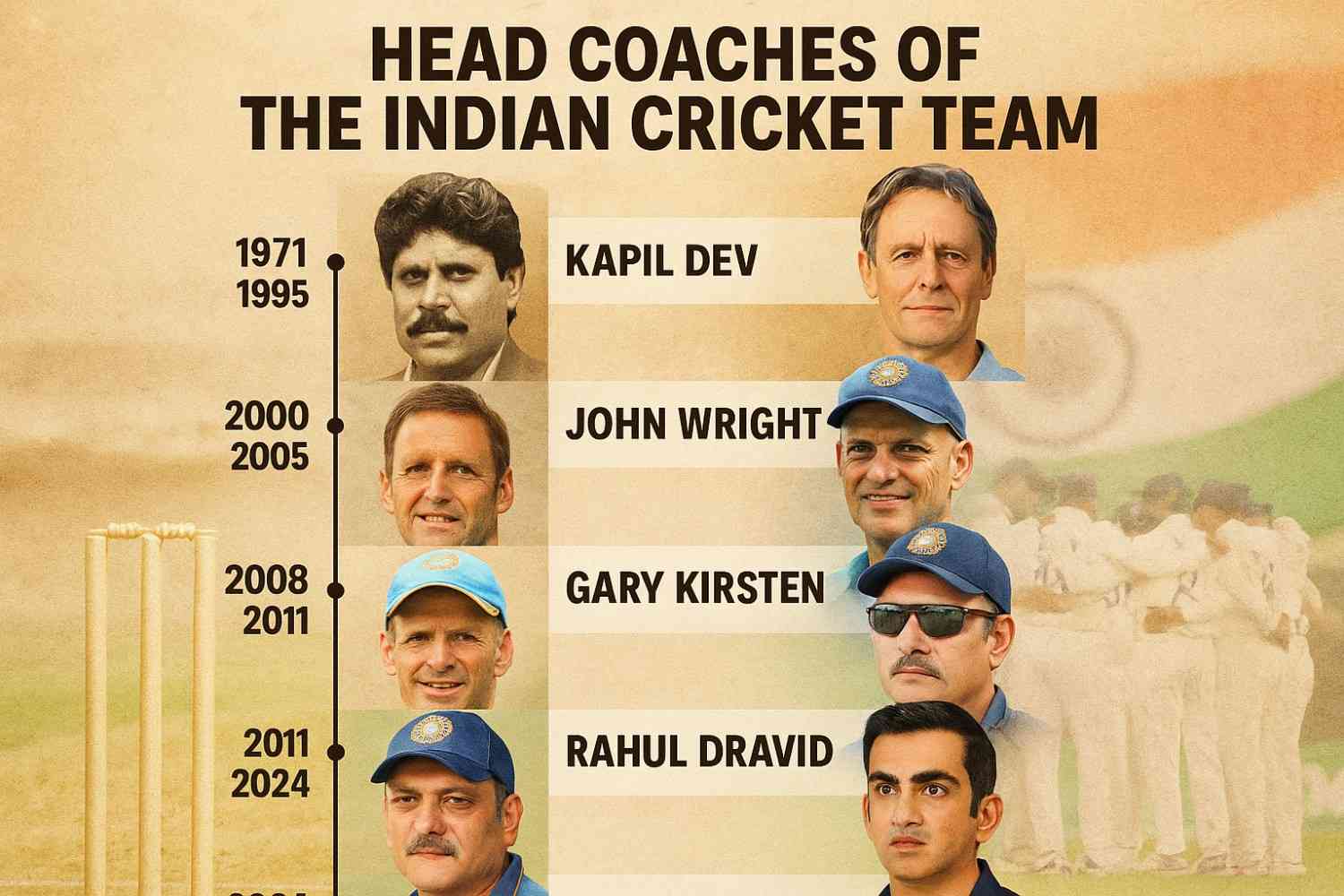
The following table showcases a chronological list of all Indian national team head coaches, their tenure, and their country of origin:
| No. | Coach Name | Tenure | Origin |
|---|---|---|---|
| 1 | Keki Tarapore | 1971 | India |
| 2 | Hemu Adhikari | 1971–1974 | India |
| 3 | Gulabrai Ramchand | 1975 | India |
| 4 | Datta Gaekwad | 1978 | India |
| 5 | Salim Durrani | 1980–1981 | India |
| 6 | Ashok Mankad | 1982 | India |
| 7 | PR Man Singh | 1983–1987 | India |
| 8 | Chandu Borde | 1988 | India |
| 9 | Bishan Singh Bedi | 1990–1991 | India |
| 10 | Abbas Ali Baig | 1991–1992 | India |
| 11 | Ajit Wadekar | 1992–1996 | India |
| 12 | Sandeep Patil | 1996 | India |
| 13 | Madan Lal | 1996–1997 | India |
| 14 | Anshuman Gaekwad | 1997–1999 | India |
| 15 | Kapil Dev | 1999–2000 | India |
| 16 | John Wright | 2000–2005 | New Zealand |
| 17 | Greg Chappell | 2005–2007 | Australia |
| 18 | Ravi Shastri (Interim) | 2007 | India |
| 19 | Lalchand Rajput | 2007–2008 | India |
| 20 | Gary Kirsten | 2008–2011 | South Africa |
| 21 | Duncan Fletcher | 2011–2015 | Zimbabwe |
| — | Ravi Shastri (Director) | 2014–2016 | India |
| 22 | Sanjay Bangar (Interim) | 2016 | India |
| 23 | Anil Kumble | 2016–2017 | India |
| — | Sanjay Bangar (Interim) | 2017 | India |
| — | Ravi Shastri | 2017–2021 | India |
| 24 | Rahul Dravid | 2021–2024 | India |
| 25 | VVS Laxman (Interim) | 2024 | India |
| 26 | Gautam Gambhir | 2024–Present | India |
Evolution of Coaching in Indian Cricket
1970s–80s: The Foundation Years
The early days of Indian coaching were informal. Coaches like Hemu Adhikari and Keki Tarapore weren’t just tacticians—they were disciplinarians who laid the groundwork for professionalism. However, cricket boards were yet to embrace a full-time coaching structure.
In 1983, under PR Man Singh, India achieved its first World Cup victory. Though more of a manager than a coach in modern terms, his leadership was pivotal.
1990s: A New Era of Structure
The ’90s saw India experimenting with several coaches from former players like Ajit Wadekar and Anshuman Gaekwad to the legendary Kapil Dev, who transitioned from a player to a coach in 1999. The role became more defined during this period, especially with the increasing influence of media and expectations from fans.
2000–2011: The Foreign Influence
Hiring John Wright, a New Zealander, in 2000 was a turning point. He introduced discipline and a calm mindset that transformed India into a formidable team overseas. His partnership with Ganguly is still considered iconic.
Following Wright came Greg Chappell, an Australian whose tenure was marred by controversies despite his vision for youth development.
But it was Gary Kirsten, appointed in 2008, who earned the highest praise. Under him, India lifted the ICC World Cup in 2011, thanks to his quiet efficiency and strong rapport with players.
2011–2021: The Dynamic Decade
Duncan Fletcher, the former Zimbabwe captain, oversaw a phase of transition post-World Cup glory. Then came Ravi Shastri, whose multiple stints (as team director and later head coach) were defined by bold strategies and overseas Test success.
Shastri’s tenure included a historic Test series win in Australia in 2021 and made India a top-ranked Test team.
Rahul Dravid Era: Youth First (2021–2024)
Known as “The Wall,” Rahul Dravid was praised for his work with India A and U-19 teams before taking charge of the national team in 2021. He emphasized structure, data analysis, and nurturing talent.
Under his guidance:
- Young players like Shubman Gill, Arshdeep Singh, and Ishan Kishan emerged as key contributors.
- India maintained consistent performances in bilateral series.
- However, an ICC trophy eluded him.
Gautam Gambhir Takes Over (2024–Present)
Former opener and World Cup hero Gautam Gambhir was appointed as the head coach in mid-2024. Known for his fearless mindset and no-nonsense attitude, Gambhir is expected to bring an aggressive and clear-thinking culture to the team.
Expectations from Gambhir’s Coaching Tenure:
- Mental toughness and killer instinct.
- Strong team selection based on form, not reputation.
- ICC silverware aspirations in 2025 and beyond.
Impact of Coaching on Indian Cricket
Over the decades, coaches have evolved from passive selectors to active mentors, analysts, and decision-makers. A successful coach today must be:
- A strategist who understands global cricket dynamics.
- A motivator who manages egos in the dressing room.
- A communicator with clarity and confidence.
Coaching Stats & Achievements
| Coach Name | Major Achievement |
|---|---|
| PR Man Singh | 1983 World Cup Win |
| John Wright | 2003 World Cup Final |
| Gary Kirsten | 2011 ICC World Cup Champion |
| Ravi Shastri | Historic Test wins in Australia, World No.1 Test |
| Rahul Dravid | Developed next-gen talent |
Key Takeaways
- India has had 26 official head coaches for the national cricket team since 1971, with coaching evolving from informal guidance to professional management.
- The early years (1971–1999) were dominated by Indian coaches who were former cricketers, focusing primarily on team morale and basic strategy rather than analytics or performance metrics.
- Foreign coaches began with John Wright (2000–2005), ushering in a modern, structured approach that emphasized discipline, fitness, and mental preparation.
- Greg Chappell’s tenure (2005–2007) was one of the most controversial, marked by internal conflict and criticism of team culture shifts.
- Gary Kirsten (2008–2011) is widely regarded as one of India’s most successful coaches, leading the team to win the ICC World Cup in 2011.
- Ravi Shastri held multiple roles—interim, team director, and full-time head coach—contributing to India’s strong overseas performances and World Test Championship final qualification.
- Rahul Dravid (2021–2024) brought a youth-focused approach, emphasizing player development from the grassroots through India A and U19 systems.
- As of 2025, Gautam Gambhir is the current head coach, bringing in a fresh and aggressive mindset shaped by his IPL experience and international career.
- The Indian coaching journey reflects a shift from instinctive leadership to data-driven, high-performance management across all departments—batting, bowling, and fielding.
- India’s coaching roles are now highly specialized, with format-specific support staff and constant evolution in strategy, workload management, and fitness programs.
FAQ’S
1. Who is the best cricket coach of India?
Gary Kirsten is often regarded as the best cricket coach India has had. Under his leadership, India won the 2011 ICC Cricket World Cup and reached the No.1 Test ranking. His calm demeanor, tactical acumen, and excellent man-management skills earned him immense respect from players and fans alike.
2. Who is the new coach of India?
As of 2025, Gautam Gambhir is the newly appointed head coach of the Indian cricket team. A former opener and World Cup winner, Gambhir brings a competitive mindset and IPL experience to the role, with a vision to lead India to major global titles across formats.
3. Who is the legendary coach of India?
Ramakant Achrekar is considered a legendary cricket coach in India. Though not a national team coach, he mentored Sachin Tendulkar and many young cricketers in Mumbai. His influence on grassroots cricket and his contribution to Indian cricket history remain unparalleled.
4. Who trained Virat Kohli?
Virat Kohli was initially trained by Rajkumar Sharma at the West Delhi Cricket Academy. Sharma played a crucial role in shaping Kohli’s technique, discipline, and work ethic from a young age, laying the foundation for his international success.
5. Who is the coach of Tendulkar?
Sachin Tendulkar’s childhood coach was Ramakant Achrekar. He played a pivotal role in nurturing Tendulkar’s talent and instilling a strong foundation in technique and discipline. Achrekar’s coaching legacy is widely credited for shaping one of the greatest batsmen in cricket history.
6. Why is Rahul Dravid so famous?
Rahul Dravid is famous for his legendary cricket career and immense contribution as a coach. Known as “The Wall,” he was a dependable Test batsman. Later, he became a successful coach, guiding India A, U19 teams, and the senior national team with a focus on development and consistency.
7. Who is Gautam Gambhir coach of India?
Gautam Gambhir was appointed as head coach of the Indian national cricket team in 2024. His aggressive mindset, strategic thinking, and experience as a top-order batsman bring a new dimension to India’s coaching setup. He succeeds Rahul Dravid in the role.